
Research Dossier for Target Company
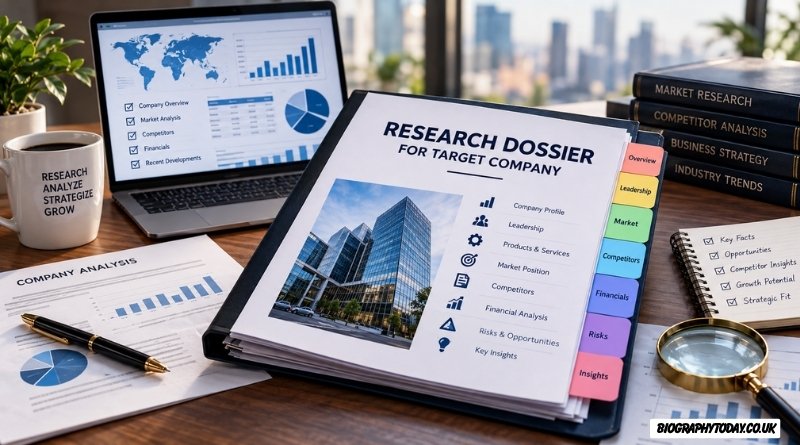
A research dossier for target company is a structured collection of information about a business, its market position, competitors, leadership, products, financial activity, customers, and potential risks. It helps researchers, marketers, investors, sales teams, and business professionals understand a company before making an important decision.
What Is a Research Dossier for Target Company?
A research dossier brings important company information into one organized document. Instead of collecting scattered facts from different sources, researchers can arrange the findings into clear sections.
A good dossier may cover the company’s history, ownership, leadership, products, services, customers, competitors, online presence, industry position, and recent developments.
The goal is not simply to collect information. The information should help answer practical questions about the company and its business environment.
Why Is Company Research Important?
Business research can reduce uncertainty before entering a partnership, contacting a prospect, investing in a company, or analyzing a competitor.
A well-prepared research dossier for target company can help identify:
- Business opportunities
- Potential risks
- Key decision-makers
- Major competitors
- Market trends
- Products and services
- Company strengths and weaknesses
- Recent business developments
- Possible partnership opportunities
Clear research also makes it easier for different team members to work from the same information.
Key Information to Include in a Company Dossier
Company Overview
Start with basic information about the business. Include the company name, founding year, headquarters, industry, website, business model, and major areas of operation.
This section should give readers a quick understanding of what the company does without requiring them to read the entire document.
Leadership and Ownership
Identify important executives, founders, directors, and other publicly documented decision-makers.
Where possible, include their professional background, current position, and responsibilities. Ownership information can also be useful when it is publicly available and relevant to the research objective.
Products and Services
Document the company’s main products and services. Explain what each offering does and which customer group it appears to serve.
Look at the company’s website, product pages, brochures, announcements, and other reliable sources to understand its current offerings.
Target Customers
Understanding the company’s customers is an important part of business research.
Consider whether the company primarily serves consumers, small businesses, enterprises, government organizations, or a specific professional sector. Note any publicly stated customer segments or industries.
How to Research a Target Company
Creating a research dossier for target company requires information from multiple reliable sources rather than relying on one website.
Start With the Official Website
The company’s official website is usually the first place to investigate. Review its:
- About page
- Product and service pages
- Leadership information
- Press releases
- Blog
- Careers section
- Contact information
- Investor information
The website can provide useful first-party information about how the company presents itself.
Check Business and Corporate Records
Depending on the company and country, corporate registries, regulatory filings, annual reports, and other official records may provide additional information.
These sources can help verify details such as registration, directors, subsidiaries, corporate structure, and reported financial information.
Review Industry and News Sources
News publications and reputable industry websites can reveal important developments that may not appear on the company’s own website.
Look for information about acquisitions, product launches, partnerships, leadership changes, expansion, legal developments, and other significant events.
Competitor Analysis
A strong company dossier should also examine the competitive environment.
Identify direct competitors offering similar products or services. Then consider indirect competitors that solve the same customer problem through a different approach.
Useful comparison points include:
- Product range
- Pricing approach
- Target market
- Geographic coverage
- Brand positioning
- Technology
- Customer experience
- Distribution channels
The purpose is to understand the company’s position rather than simply create a list of competing businesses.
Financial and Business Performance
Financial information can provide valuable context when it is publicly available.
For public companies, researchers can examine annual reports, quarterly filings, revenue figures, profitability, debt, acquisitions, and other disclosed metrics.
For private companies, information may be more limited. Researchers should clearly distinguish verified financial data from estimates or third-party claims.
Avoid presenting an estimated figure as confirmed information.
Online Presence and Digital Footprint
A company’s digital presence can reveal how actively it communicates with customers and the wider market.
Review its website, social media profiles, professional networks, review platforms, published content, and search visibility.
Pay attention to:
- Website quality
- Content activity
- Customer engagement
- Brand messaging
- Reviews and feedback
- Search visibility
- Recent announcements
These observations can provide useful clues about marketing priorities and customer communication.
Assessing Company Strengths and Risks
The research dossier for target company should not only describe the business. It should also organize relevant findings into strengths, challenges, opportunities, and risks.
For example, strengths might include an established brand, strong distribution network, proprietary technology, or diversified products.
Potential risks could include heavy dependence on one market, regulatory exposure, intense competition, leadership changes, or negative developments reported by reliable sources.
Any interpretation should be clearly separated from verified facts.
Keeping Research Accurate
Accuracy is one of the most important parts of company research.
Information can become outdated quickly, especially when it concerns executives, products, ownership, financial performance, or business strategy.
Use publication dates and, when appropriate, record the date on which each piece of information was verified.
It is also useful to compare important claims across more than one reliable source.
How to Organize the Final Dossier
A practical research dossier for target company can follow this structure:
| Section | Information to Include |
|---|---|
| Company Overview | Industry, location, history, business model |
| Leadership | Executives, founders, directors |
| Products | Main products and services |
| Customers | Target audiences and industries |
| Competitors | Direct and indirect competitors |
| Financials | Publicly available financial information |
| Digital Presence | Website, social platforms, online visibility |
| Market Position | Industry role and competitive landscape |
| Recent Developments | News, launches, partnerships, acquisitions |
| Risks | Documented business and market risks |
| Opportunities | Potential areas for growth or engagement |
| Sources | Links and publication dates |
This format makes the research easier to review and update.
Common Mistakes to Avoid
Researchers sometimes make a dossier unnecessarily complicated. More information does not always mean better research.
Avoid copying large amounts of text from websites. Instead, summarize relevant findings in clear language.
Do not rely heavily on outdated pages or anonymous claims. Avoid confusing opinions with documented facts.
Another common mistake is failing to record sources. Every important factual claim should be traceable to its original source.
How a Research Dossier Supports Business Decisions
A company dossier can support several business activities. Sales teams can use it to understand prospects before outreach. Marketing teams can study competitors and identify positioning opportunities.
Investors and analysts can use company research to organize publicly available information before conducting deeper analysis.
Researchers can also use the dossier as a starting point for due diligence, partnership evaluation, market research, or competitive intelligence.
Final Thoughts
A research dossier for target company should be clear, organized, current, and based on reliable information. Its value comes from turning scattered business information into a useful research resource.
The best approach is to combine official company information with credible external sources, verify important claims, identify recent developments, and clearly separate facts from analysis.
When updated regularly, a well-structured dossier can become a practical reference for sales, marketing, investment research, competitive analysis, and strategic planning.